Slop Bowls and the Art of Doing Just Enough
I can’t even count how many times I’ve visited that hangry zone where my brain has shut down. My cravings spike when I’m running on back-to-back business trips, or chasing a ridiculous deadline that feels impossible to reach. During these times, all I want is something to restore my happiness again without compromising my health. I want something I can practically scarf down with water without worrying about any inflammatory aftermath. Ideally, I’d much prefer a Sweetgreen bowl and places alike as opposed to fries from McDonalds or nuggets from Wendys (my ultimate weakness). I’d say these bowls are good enough to meet basic nutritional goals. And for an on-the-go airport meal packed with high-protein, they’re lifesavers.
These bowls check all the boxes for being healthy, filling, convenient, etc. But they don’t always hit the mark. My hanger subsides with some cravings lingering. Am I just eating a sad salad? Something always seems to be missing whether that’s a bit more dynamic flavors, freshness, or something that makes eating feel less like a chore to stay alive and more like a small win throughout hectic work hours.
Most of us have been here searching for “better” options so we can feel energized and satisfied. Despite these bowls giving us life after long hours of stress, I don’t think we can call this type of food soul satisfying. There is, after all, some truth in the whole “you cant beat a homemade meal,” which is associated with a hearty and warm dish, something thats not successfully achieved in our Chipotle bowls.
A Brief Rundown of Slop
Towards the end of 2025, I noticed the term slop popping up on my feed. Some definitions came to mind like sloppy work, sloppy mess, sloppy Joe, etc. But the word made it’s way to Webster and provides it’s official definition: slop is the digital content of low quality that is produced usually in quantity by means of artificial intelligence. This is just the umbrella term for a describing something that goes way beyond digital content.
Slop culture is the growing acceptance of low-effort, low-care output as a practical response to burnout most of us experience today. It’s a coping mechanism for a modern world where “gets the job done” replaces pride, and volume replaces craft.
More specifically within this framework, slop food represents slop culture at the system level as being mass-produce, cheap, and usually visually unappealing. It’s designed to forget about offering something to delight the tastebuds and introduces the concept of meeting basic needs as efficiently as possible. Think of a melting pot of food like seasoned ground beef, leftover rice, canned beans, shredded cheese, and sometimes a flood of sauce all piled and mashed together in a sad, shapeless mess. School cafeteria food comes to mind where I remember having no say in the matter. One day it was a greasy, limp sloppy Joe, another day it was powdered mashed potatoes and broccoli that had seen better days. Lunch was more about keeping us alert in class than actually giving us anything nutritious.
School cafeteria menus (much like other spaces like hospital food) are designed for risk management instead of pleasure. Texture and seasoning are flattened so no one complains, and presentation doesn’t matter because eating is a biological task. The point is that your experience isn’t the priority. Even when it technically meets nutritional standards and keeps you full, slop food rarely makes you feel emotionally and/or psychologically fulfilled.
Slop bowls follow the same logic on a more personalized level. These are considered more “healthy” meals from fast-casual places like Chipotle, Sweetgreen, Cava, etc. Unlike school cafeteria food, the individual has the choice to tailor their meals with more nutritional options. You can start with a base either grains, greens, or protein, then add on whatever else is available whether that’s more veggies, protein, and several sauces, all dumped into one bowl. They’re satiating enough, hassle-free, and technically good for you, especially when you’re tired, stressed, or just trying to get through the day. But everything blends together into a single, indistinct mass. The ingredients are healthy, but speed and convenience erode structure and/or mindfulness to flavor where we can’t taste individual ingredient on it’s own.
The difference between slop food and slop bowls is emotional. Slop food imposes a reminder of neglect or powerlessness on us where we don’t have a choice in the matter. Slop bowls, on the other hand, feel protective, even reassuring as a way to conserve energy when life becomes overwhelming. One alienates, while the other numbs. Both reduce eating to fuel for very different reasons.
Food Distribution and Transparency
The rise of slop food and bowls are inseparable from the consolidation of food distribution. In the 20th century, restaurants mostly sourced local ingredients. Today giant distributors like Sysco, US Foods, and PFG supply the majority of restaurants nationwide. Together, they control roughly a third of the U.S. foodservice distribution market, reaching hundreds of thousands of locations across restaurants, schools, hospitals, etc. They sell ingredients under a efficiency-oriented, uniform model where they offer pre-prepped, portioned, and standardized components that are engineered to cut labor costs and control consistency. As margins shrink and prices rise, we see that even high-end restaurants depend on these systems. Slop bowls have adopted the same model where ingredients are assembled to produce expandable and reliable meals.
Sweetgreen doesn’t run like a traditional diner or cafeteria rolling Sysco or PFG trucks straight to the counter, but it still exists within the same centralized food system. The brand takes pride in their transparency, where they lean on local farms and emphasizes relationships with regional growers. Scale, however, has a way of bending ideals. Hundreds of locations require regional produce aggregators, national protein suppliers, and centralized prep hubs. Lettuce and greens are often pre-washed and pre-portioned from regional distributors instead of being hand-picked from a single farm. Chicken or tofu, for example, are prepared offsite so every bite tastes the same in every location.
Chipotle, Cava, Panera, etc., all play the same game, just dressed in different branding. Chipotle is transparent about it like its Sweetgreen cousin, relying on national suppliers for beans, grains, and proteins and keeping a tight menu that maximizes ingredient reuse. They even use marketing on the people behind the counter who wear shirts that say “As Real As it Gets.” Cava leans on centrally made spreads, dips, and sauces to lock in flavor and streamline assembly. Panera ships pre-baked breads and pre-cut veggies from centralized bakeries and distribution hubs to ensure uniformity across locations.
So even if the supplier isn’t Sysco by name, the logic is identical to be consistent and cost effective, making fast-casual chains scalable.
Homogeny at the Expense of Craft
I sometimes find restaurant menus having all the same things. I feel like I’ve seen many restaurants (excluding Michelin star ones) offer the same risotto, hot honey anything, or sweet and spicy (fill in the blank). Centralized food systems have produced a national menu where restaurants differ in branding and interior design, but the food is pretty interchangeable. Mid-tier, family-owned spots have been pushed out by franchises and fast-casual slop bowl concepts who rely heavily on distributor-friendly ingredients that can be recombined endlessly without altering the supply chain. What looks like customization is really just rearranging the same standardized parts.
Slop food, then, is the logical outcome of a system that rewards speed, homogeny, and business growth over care and individuality.
Offsite preparation then shapes how food feels and how we experience it. When ingredients arrive washed, cut, and cooked from a central facility, every location ends up producing the same textures, flavors, and portions. Many fine-dining chains now source pre-portioned proteins, pre-cut vegetables, or pre-made sauces from centralized distributors rather than preparing them entirely in-house. A dish like a classic risotto might arrive in the kitchen with partially cooked rice, pre-measured portions of stock, and pre-grated cheese. All the chef needs to worry about is putting them together in an assembly line instead of crafting the elements from scratch. Predictability can thus be secured and labor reduced at the expense of uniqueness. Over time, carefully composed flavors and nuances disappear and most restaurants across the country serve nearly identical dishes that differ only in plating or branding.
A centralized food system shifts labor and complexity away from the people behind the counter, making efficiency the priority and training both institutions and customers to accept meals that are just “pretty good.” This shapes food culture itself, normalizing monotony over pleasure and/or artistry.
In other words, the system turns food into a formula of being easy and fast, but rarely exciting.
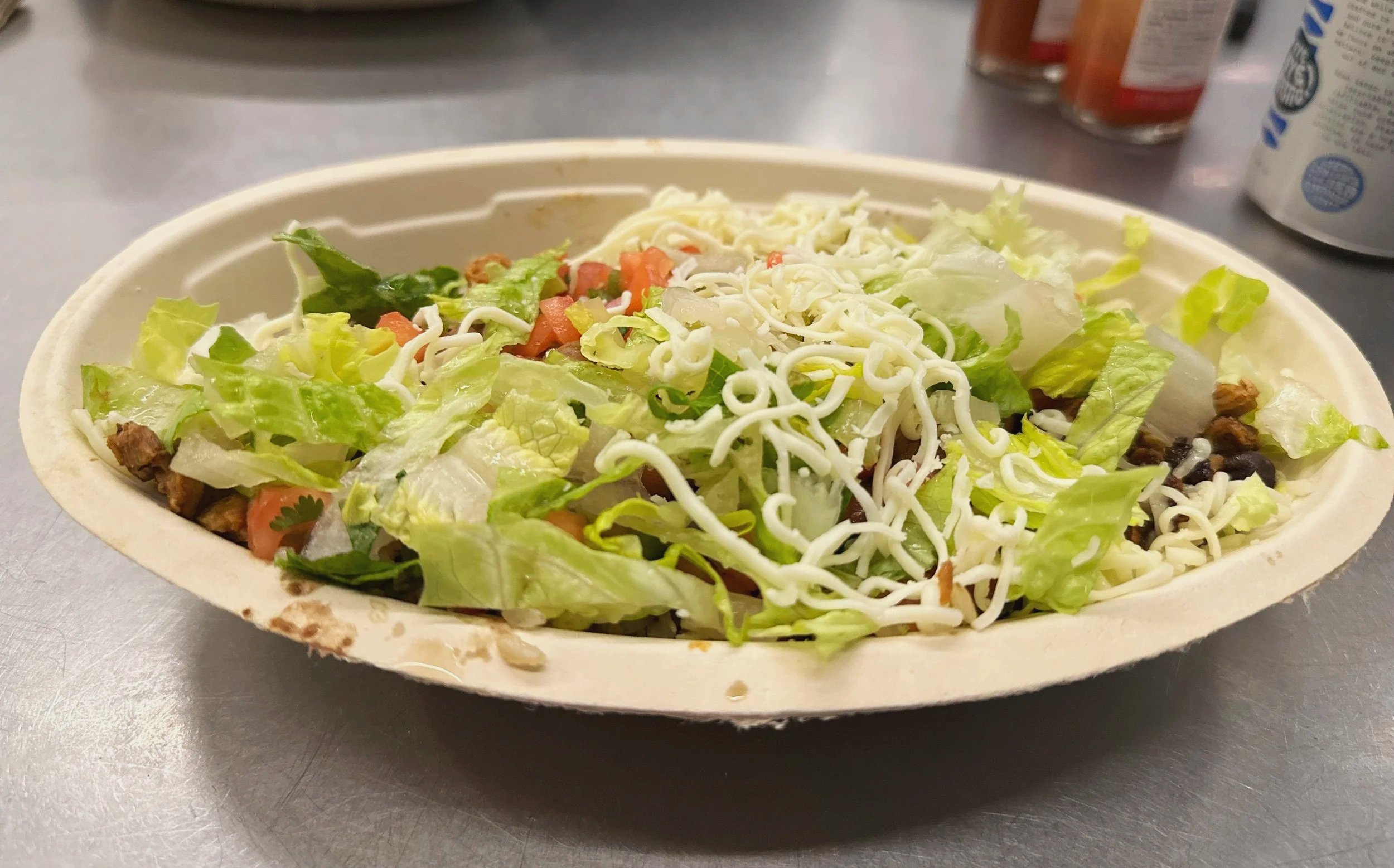
My recent Chipotle meal highlights this point: The lettuce was crisp, the chicken was a little salty but well-seasoned, the cheese was only a small sprinkle, and the small amount of pico I added gave it a pretty strong zest. The portion was filling without being excessive and, for calorie tracking purposes, I’d say it was pretty reliable. But a big trade-off of all this was that the flavor profile was undetectable since everything was completely blurred. Everything lands somewhere between acidic and spicy, without any single ingredient standing on its own. The sauce I used on the side and little of carried most of the taste because everything else was toned down, hot and cold temperatures collapsed into a lukewarm middle, and each bite tasted identical. The beans, the rice, the chicken, the lettuce were all homogenized in a creamy tangy bowl without any contrast between the ingredients.
The opposite would be a carefully balanced dish where each ingredient stands out individually to contribute to the complexity of flavor in a single plate. Instead of everything being mixed together into one indistinct profile, the elements are prepared and placed with intention, so you can taste the sweetness of a carrot or the saltiness and/or brine of the cheese, etc. It’s thoughtful food where the experience comes from noticing how distinct pieces work together.
Bowl By Numbers
Both slop bowls and algorithmic AI culture turn creation into a formula for optimal output. Just as centralized kitchens prep ingredients offsite so every bowl tastes roughly the same across hundreds of locations, AI utilizes standardized models to generate content that is deemed reliable and useful. Different inputs go in, a predictable, averaged output comes out. Everything is tracked in a formulaic manner to yield the most optimal outcome.
AI flattens complexity as much as slop bowls do with their flavors. Distinct elements like texts, images, and data are muddled together and intentionally designed to satisfy the widest possible middle rather than a specific desire. My Chipotle bowl follows the same principle in which the ingredients are chosen to keep me fueled no matter which location I’m at. I can order the same bowl with the same arrangements in any of their locations and I’m guaranteed it’ll taste the same, fill me up, and get me through the day. It’s not exciting, but at least it’s reliable.
A slop bowl also combines whatever ingredients happen to be available without understanding why certain flavors work together. It can be good or bad, but it’ll always be a blend of things that already exist. AI operates the same way where it pulls from massive amounts of existing data and combines patterns to create something that looks new without actually understanding what it’s making. In the end, when the result turns out really good, it’s because the ingredients happened to work well together. My bowl came out to be so good by chance, not because someone carefully curated every single ingredient in there.
Convenience Culture
Slop culture, whether in bowls or algorithms, is built to be fail proof so that meals taste safe and content feels predictable, quietly shrinking our expectations. Slop food thrives in convenience culture as being quick and requires little thought. Removing friction also removes experience. When we get used to slop bowls, flavors are blended together and meals stop being something we notice. A dish with real texture or surprises feels like a luxury. When algorithmic feeds become normalized, originality and thought start to feel like work and less demanding.
Modern life only reinforces this. Endless notifications via phone call, text, email, Teams meeting reminders, constant scrolling to numb us out of existence, and the pressure to optimize every minute of everyday only push us toward food and media that are just easy. We eat alone, quickly, often distracted, treating meals as fuel rather than moments. Practicality becomes a kind of virtue in a culture that is intensely overwhelmed. And honestly that’s okay sometimes. When life gets chaotic, a bowl that fills you in three minutes can feel like a small act of self-preservation.
To give slop bowls credit, they are at least honest. They don’t pretend to be gourmet, they don’t demand Instagram glory, and they’re not trying to polish themselves. They’re just saying “this is what I can manage today”. In a culture obsessed with curated experiences, a meal that just works to get us by can remind us that nourishment doesn’t always need to be this beautifully crafted image from a high end restaurant.
Still, defaulting to slop eliminates taste and connection. Meals stop being opportunities to notice the tang of a citrus dressing or the crunch of fresh greens. Every bite becomes predictable and forgettable, especially when it’s the same almost everywhere. At the same time, the social richness of eating fades. Meals that have moments to share stories or be present with others wane into solitary, distracted bites eaten over a screen or between meetings. The ritual element of eating that brings people together or allows us simply enjoying a dish on it’s own, becomes a task to check off our to do lists.
Institutions create slop because people are exhausted. And in return, people accept slop since systems trained them to value ease over intention. It’s a cycle that quietly teaches us to lower our expectations on taste, experiences, and connection. The cycle continues until care is reintroduced through small acts of intention. Maybe sometimes we can leave some space for slowing down and make small choices like creating a flavor profile by separating ingredients, savoring flavors, or deciding that one bite deserves more than survival.